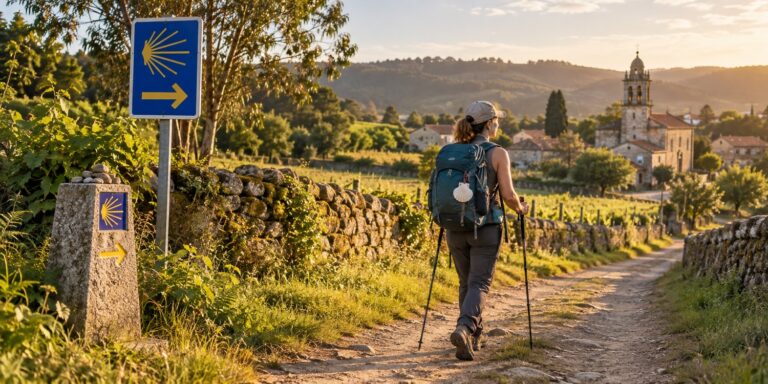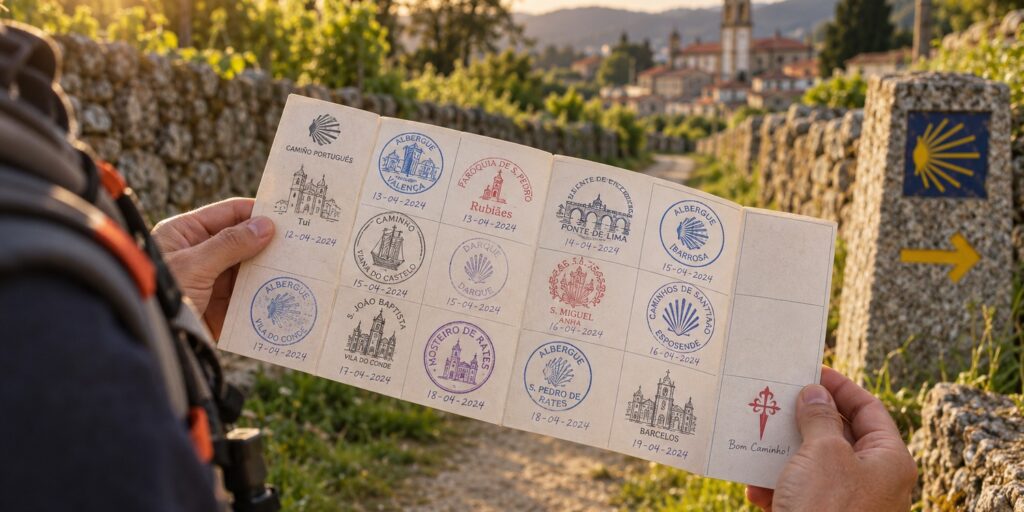

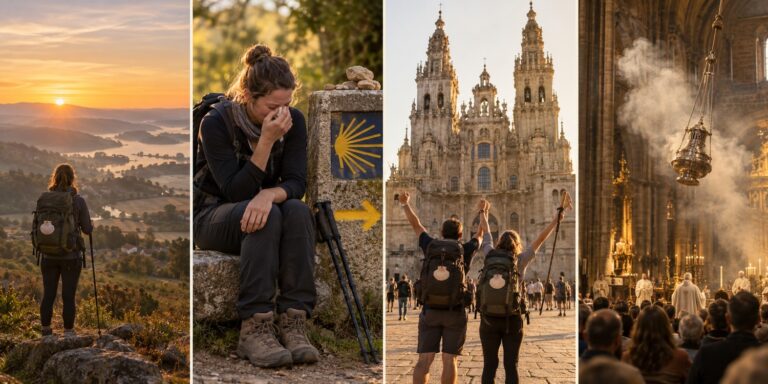


Along the Camino de Santiago, few moments are as special as stopping to get your credential stamped. Each stamp is the mark of a place, a pause, a person you met along the way.
Even so, practical questions always come up: where do you get it stamped? How many stamps do I need per day? And what happens if I’m missing one at the end? Is it mandatory? Does it cost anything?
This article answers all of those questions. You’ll find out exactly where to get your pilgrim’s credential stamped, how often to do it, and how to make sure you have everything in order to request your Compostela.
Table of Contents
Why getting your credential stamped matters
Stamps serve two purposes. The first is practical: they prove where you’ve been and are the requirement for getting the Compostela and other certificates at the end.
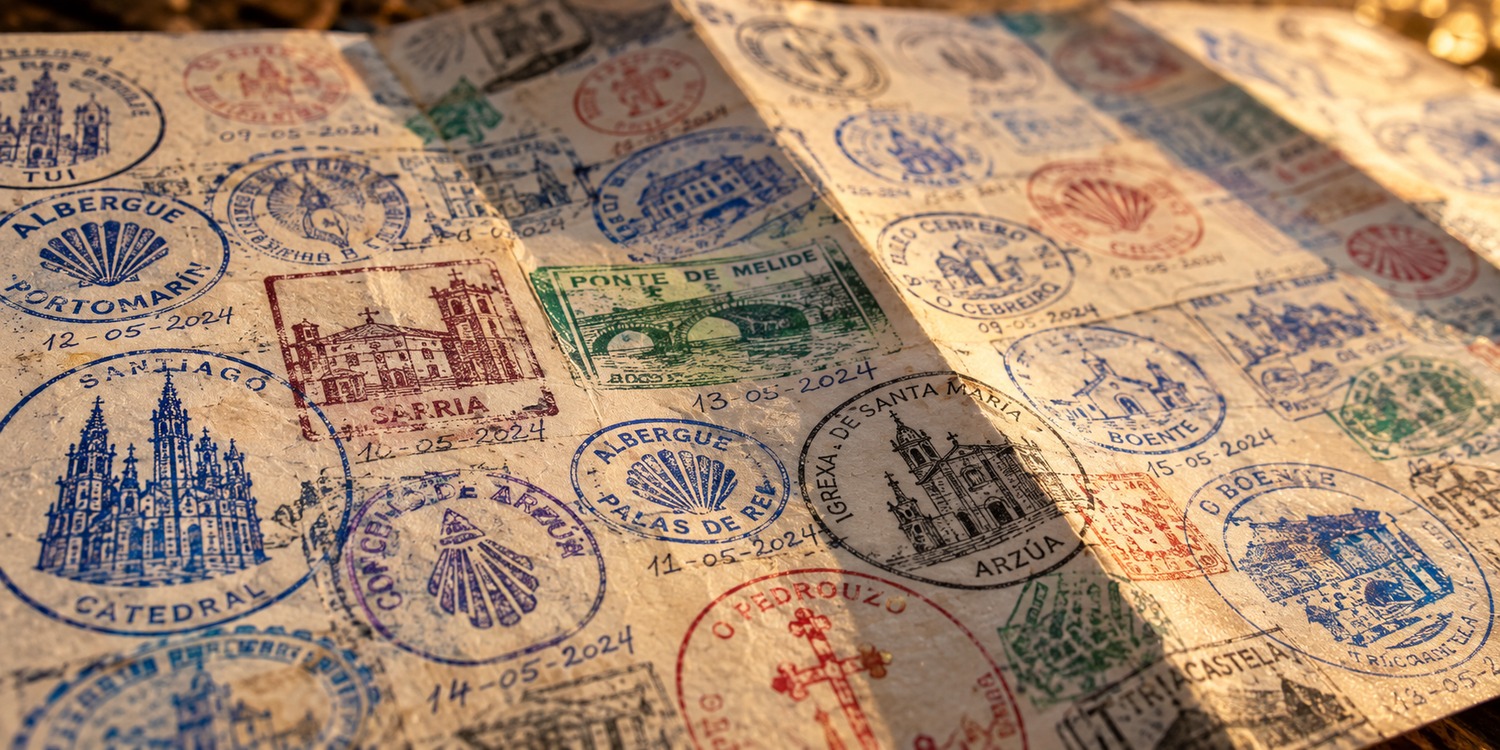
The second is sentimental. As you collect stamps from churches, pilgrim hostels, and small businesses, your credential becomes a one-of-a-kind keepsake, with your journey written in ink. Many pilgrims hold on to it for years. It may just be the most moving souvenir ever!
How many stamps do I need per day?
The number depends on what you want to get at the end. Under the Pilgrim’s Office rules:
- On foot or on horseback: at least two stamps per day over the last 100 kilometers before Santiago.
- By bike: at least two stamps per day over the last 200 kilometers.
Outside that final stretch, one stamp a day is enough to document your route. But be careful: over the last 100 kilometers, the two daily stamps are not optional if you want the Compostela.
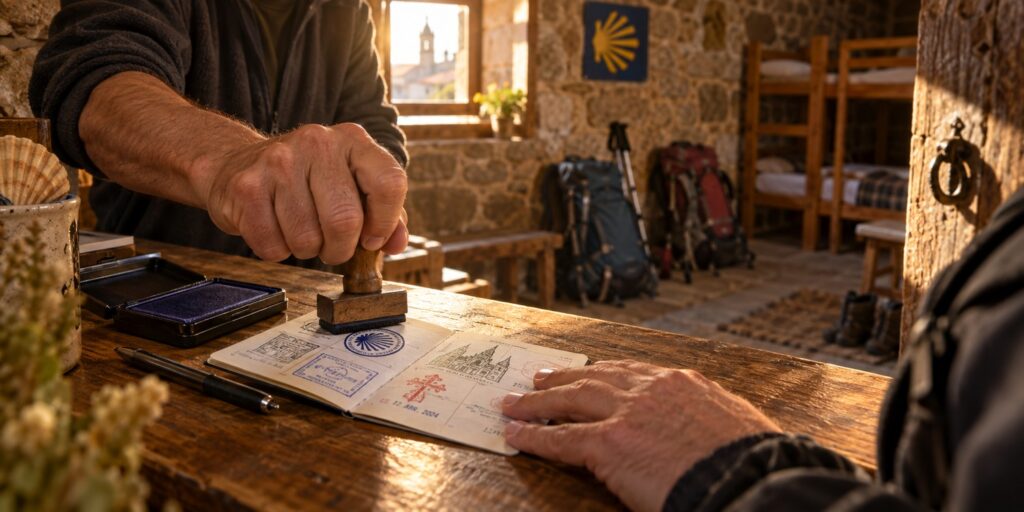
A simple rule so you don’t slip up: one stamp in the morning, at the place you set off from, and another in the afternoon or evening, where you’re staying.
Stamps must be dated
This is the detail most pilgrims overlook. A stamp without a date makes your route harder to read and can raise questions when you request your Compostela.
Many stamps already include the date automatically. When they don’t, ask for it to be written in by hand, or write it legibly next to the stamp yourself. This is perfectly acceptable and avoids problems.
Where to get your pilgrim’s credential stamped
You’ll find places to get stamped almost everywhere. The most common are:
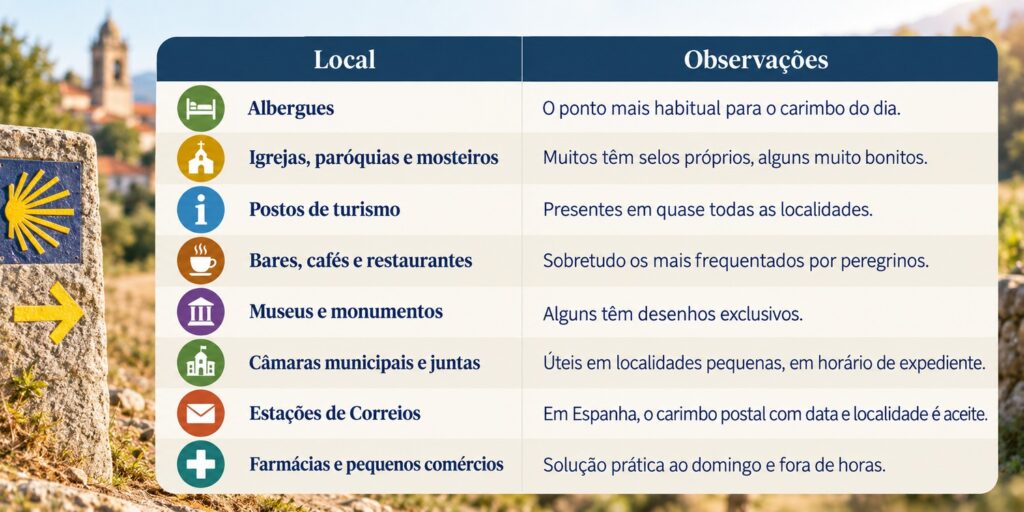
In other words, almost any establishment connected to the Camino can stamp your credential. Just ask with a smile, and if it’s at a café or a shop, it’s a nice gesture to buy something.
Read also: Pilgrim’s credential: what is it and where can you buy one?
What if everything is closed?
It happens, especially on Sundays, in small villages, and in the off-season. A few solutions that work well:
- ask at the place where you’re sleeping that night, which is always an option;
- look for the village café or grocery store, even if they don’t have a themed stamp;
- in Spain, go to the local Correos post office on weekdays;
- if the day really goes wrong, make up for it the next day with clear stamps from two different places.
Special stamps worth seeking out
If you want a memorable credential, don’t stop at the essential stamps. Along the route, there are churches, monasteries, historic cafés, and small shops with artistic, original stamps.
Some pilgrims make a point of going a few meters out of their way to get a rare stamp. It’s a nice way to get to know each village you pass through a little better.
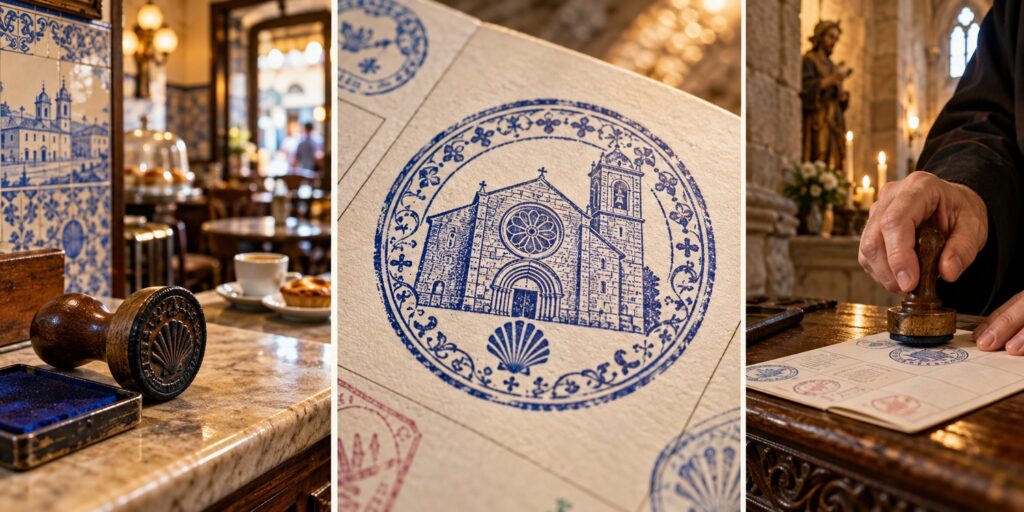
Iconic stamps along the Portuguese Way
Collecting stamps isn’t just a formality. Each one has a special meaning, and many have become symbols of the pilgrimage. If you’re walking the Portuguese Way, here are ten stamps worth looking out for:
- Lisbon Cathedral: marks the official start of the route for those setting off from the Portuguese capital.
- Monastery of Santa Clara-a-Velha, Coimbra: a sought-after stamp because it represents the city’s historical and spiritual richness.
- Porto Cathedral: one of the most iconic stamps on the Portuguese Way and the starting point for most Portuguese pilgrims.
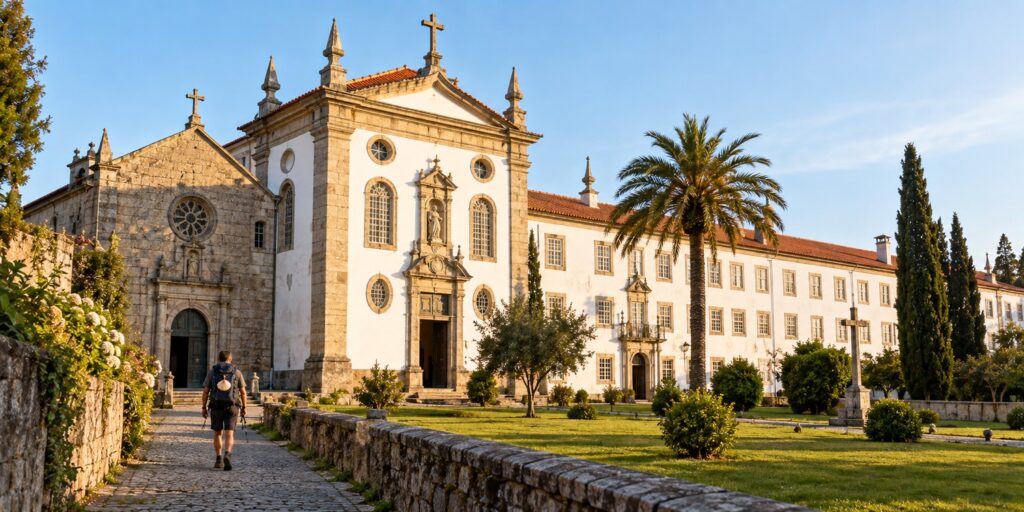
- Vairão Monastery, Vila do Conde: a place of spiritual welcome, with a truly beautiful stamp.
- Ponte de Lima Pilgrim Hostel: features the town’s famous medieval bridge.
- Valença Fortress: marks your farewell to Portugal and the crossing into Spain.
- Tui Cathedral: the first Spanish stamp, a symbol of a fresh start.
- Sanctuary of the Pilgrim Virgin, Pontevedra: one of the most revered stamps.
- Padrón Pilgrim Hostel: recalls the legend of St. James’s body being brought ashore.
- Santiago de Compostela Cathedral: the final stamp, the most coveted of all, marking your arrival at the finish line.
If you walk the Camino in stages over different years
You don’t have to walk the Camino all in one go. You can walk one section one year and pick it up again in another, and still be entitled to the Compostela, as long as the route is geographically continuous.
The practical rule is this: when you stop, get your credential stamped at the place where you stopped. When you start again, your first stamp should come from that same place, showing that you picked up exactly where you left off. That’s what makes the continuity of your route readable on the credential.
The same principle applies once you’ve chosen a route: stick to it, without switching between different routes partway through.
Practical tips for never missing a stamp
To reach Santiago without any nasty surprises, keep the following in mind:
- Over the last 100 km, make sure you get two stamps a day. One in the morning and one in the afternoon, for example.
- Dated and legible. Always check that the date and the place name can be read.
- Protect your credential from the rain. Keep it in a plastic bag or a waterproof cover.
- Get stamped as soon as you arrive in each town. That way you won’t forget at the end of the day.
- Don’t leave it in the backpack you send ahead by luggage transfer. Always keep it with you.
What to do if stamps are missing or you lose your credential
If your credential doesn’t properly prove your route, the Pilgrim’s Office may not issue the Compostela. So when in doubt, get too many stamps, never too few.
If you lose your credential, you’ll need to get a new one to keep collecting stamps. Unfortunately, the stamps from the old one can’t be recovered, which is all the more reason to always keep it somewhere safe. If you don’t have yours yet, find out how to get one in our article on the pilgrim’s credential and where to buy it.
Conclusion: every stamp, a memory
Getting your credential stamped is one of the most beautiful rituals of the Camino de Santiago. Besides securing your Compostela, each stamp holds the story of a place and a moment.
The next step is simple: always keep your credential handy, get into the habit of having it stamped twice a day on the final stretch, and protect it well. In the end, you’ll be holding much more than a document. To prepare for the rest of your trip, also take a look at our packing list for the Camino de Santiago and check how long it takes to walk the Camino. Buen Camino.