

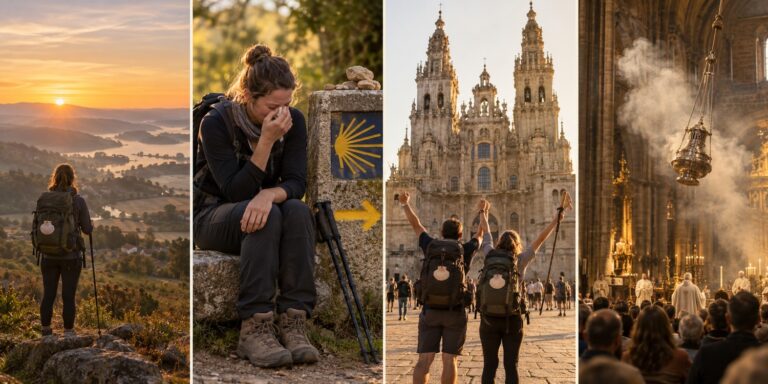


If you’re preparing for the Camino de Santiago, there’s one word you’ll hear a lot: credential. It’s a small document, but it carries enormous weight in the pilgrim experience, and it’s one you’ll keep forever.
You may be wondering whether the pilgrim’s credential is really necessary, how much it costs, or where you can get one before you leave. These are natural questions, especially if you’re walking the Camino for the first time. In this article, we explain in simple terms what the pilgrim’s credential is, what it’s for, how much it costs, and where to buy it in Portugal, so you can start your journey with everything taken care of.
Table of Contents
What is the pilgrim’s credential?
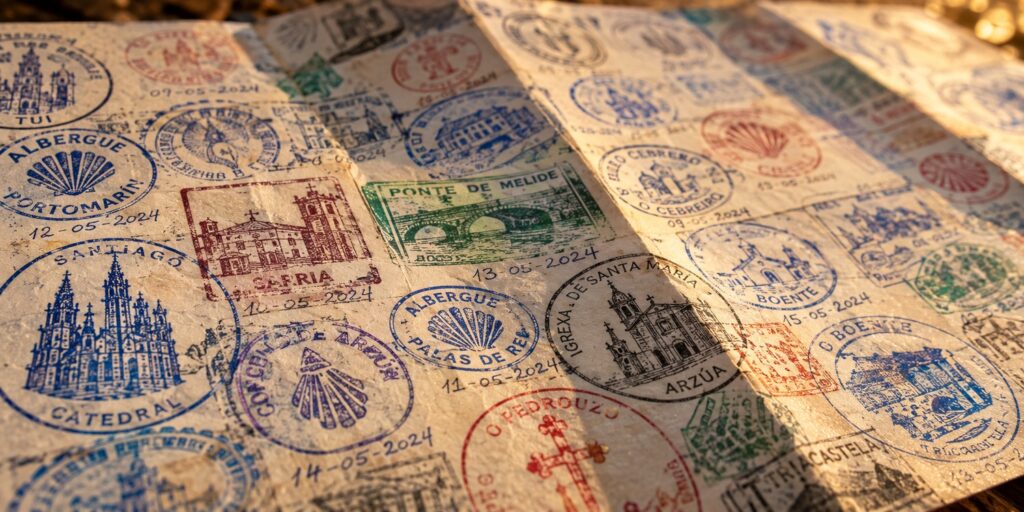
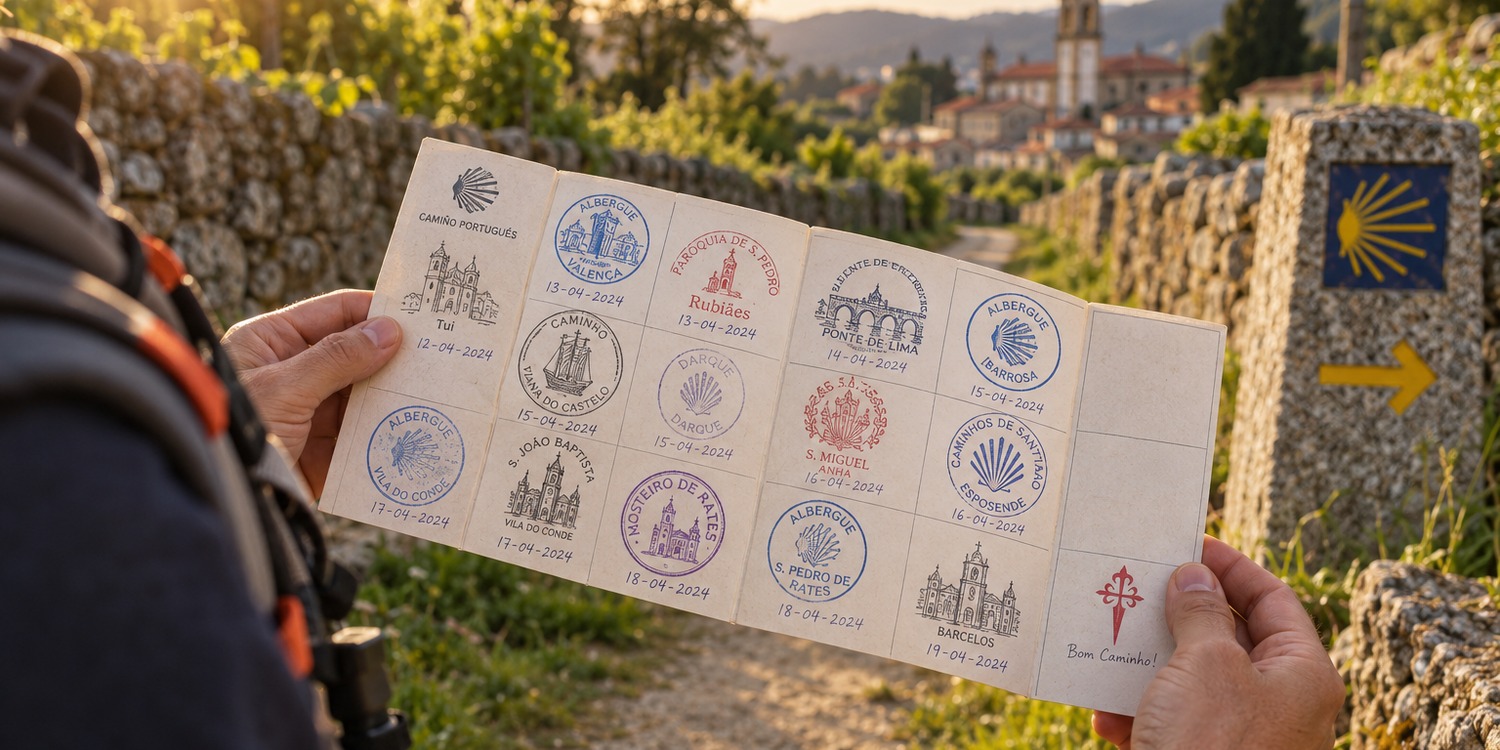
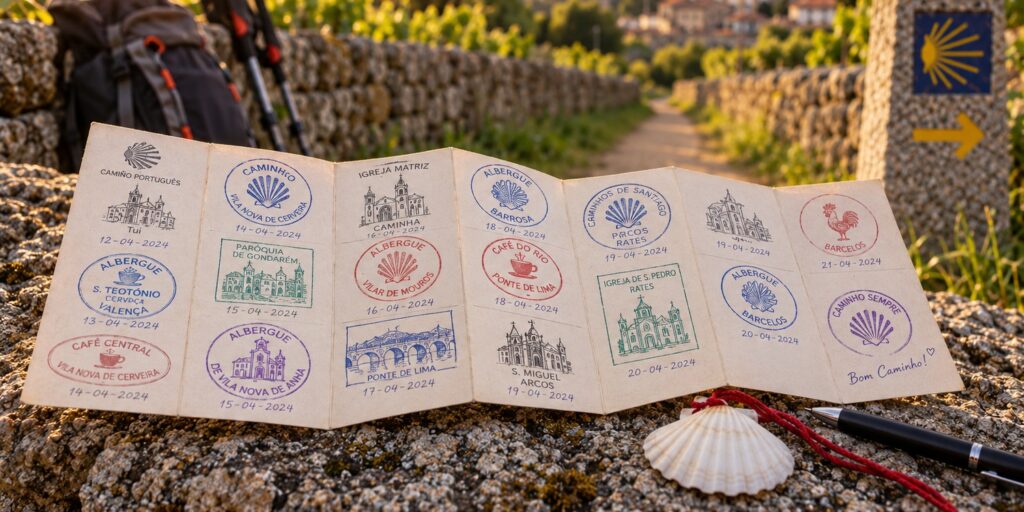
The pilgrim’s credential, also known as the Camino de Santiago credential, is the document that identifies you as a pilgrim along the route. In it, you collect stamps from the places you pass through, which serve as proof of the itinerary you’ve followed.
Its origins go back to the Middle Ages, when pilgrims carried safe-conduct passes to justify their journey and make it easier to pass through towns and villages. Today it keeps that spirit, but its main purpose is to prove your pilgrimage and allow you to request the Compostela at the end.
In practice, it’s a folding booklet made of card stock, with spaces for stamps and for your personal details. It’s valid on any official route, whether the Portuguese Way, the French Way, or another one.
Is the credential mandatory?
No, but it’s highly recommended. You can walk the Camino without one, especially if you only stay in hotels and private accommodation. However, the credential becomes essential if you want to:
- stay in pilgrim hostels, both public ones and many private ones;
- request the Compostela when you arrive in Santiago;
- get other official certificates, such as the distance certificate;
- keep a one-of-a-kind keepsake, with the stamps from each stage.
For all these reasons, the vast majority of pilgrims get their credential before setting off, even though it isn’t mandatory.
Watch out: not all credentials are valid
This is the point that causes the most confusion, so it’s worth being clear. For the purposes of the Compostela, the only credentials accepted are those issued by the Cathedral of Santiago, through the Pilgrim’s Office, or by organizations expressly authorized by it: dioceses, parishes, confraternities, and pilgrim associations.
There are plenty of decorative or commercial “credentials” on the market, sold by stores and online platforms without any authorization. They work as a souvenir, but you can’t use them to request the Compostela. Before you buy, always check who issues the document.
Where to buy the pilgrim’s credential in Portugal
If you’re walking the Portuguese Way, the good news is that you don’t need to leave the country to get your credential. These are the most common options:
- Porto Cathedral and Lisbon Cathedral. They hand out the credential from Via Lusitana, a pilgrim association authorized by the Cathedral of Santiago. It’s the most convenient option if you’re starting from Porto or Lisbon.
- Espaço Jacobeus Association (Confraternity of Saint James). It has branches in several cities around the country and also lets you request a credential remotely.
- Regional associations of Friends of the Camino de Santiago, such as the one in Ponte de Lima, each linked to its own section of the route.
- Pilgrim hostels at the main starting points, although stock varies. It’s worth calling ahead.
- Authorized parishes and churches located along the main routes.

If you’re already in Spain, you can also get one at the Pilgrim’s Office itself, in Santiago, and at many parishes and hostels along the routes.
Read also: Where should you get your pilgrim’s credential stamped?
Can I get the credential online?
There’s no official Cathedral store that will mail the credential to your home in any country, but several authorized associations accept requests by mail, charging the price of the document plus postage.
The usual procedure is to contact the association by email or fill out a form on its website, providing your details and shipping address. Do it well in advance, because delivery can take a few days.
Be wary of websites that promise the “official credential” with immediate shipping and at high prices. If the issuing organization isn’t identified, it most likely won’t be valid for requesting the Compostela.
What about the digital credential?
Since 2021, there has also been a digital credential promoted by the Cathedral of Santiago, in the form of a mobile app. It works by scanning QR codes at stamping points, and it doesn’t replace the paper credential; it complements it.
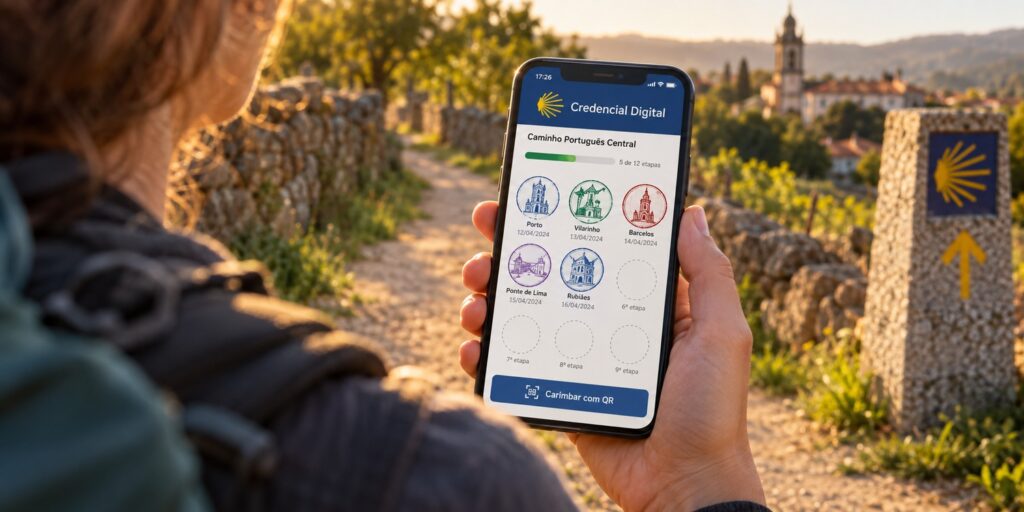
In practice, most pilgrims still use the paper version, among other reasons because not every establishment along the route has joined the QR system. If you’d like to try the digital version, bring the traditional credential with you anyway as a backup.
A recent detail: since 2026, the official credential has included a QR code to download AlertCops, the Spanish security forces’ app, which lets you call for help and share your location in an emergency. We cover this in detail in our article on whether it’s safe to walk the Camino de Santiago.
How much does the credential cost?
Not much. At the Pilgrim’s Office in Santiago, it’s around 1.50 euros. At other authorized organizations, the recommended price doesn’t usually go over 2 euros, although some associations ask only for a donation and others add a small markup for the service.
If you have it sent by mail, add the postage. And bring some cash on the day you pick it up, since several issuing points don’t accept card payments.
While we’re at it, let’s clear up a common question: the Compostela, the certificate you receive at the end, is free. The optional distance certificate costs 3 euros.
How to fill out and use the credential
Before you set off, carefully fill out the first page: full name, address, contact details, and starting point. A credential with incomplete details can cause problems when you go to request the Compostela.
A simple and very useful tip: add your cell phone number. If you lose it along the way, it’s much easier for someone to get it back to you.
After that, just keep it with you at all times, protected from the rain. The first stamp is usually added where you receive it or where you start the route. From then on, you get it stamped along the way.
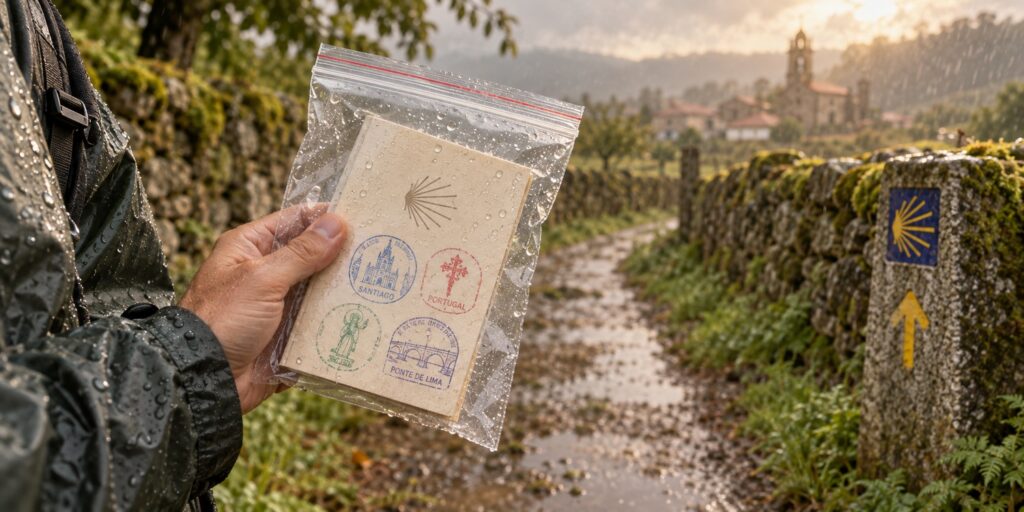
To request the Compostela as a walker, the rule is to collect at least two stamps a day over the last 100 kilometers. If you want to know everything about this, see our dedicated guide on where to get your pilgrim’s credential stamped.
Conclusion: a small document, a great keepsake
The pilgrim’s credential is much more than a passport to hostels and the Compostela. It’s the physical record of your journey, stage by stage, and one of the most treasured keepsakes for anyone who walks the Camino.
Now that you know what it is, how much it costs, and where to buy it, the next step is to get it well in advance and have it ready for your first stamp. Keep it in a dry, protected place and check out our packing list for the Camino de Santiago so you don’t forget anything else. If you’re still settling on dates, also take a look at how long it takes to walk the Camino. Buen Camino.